Peptide Therapy Evidence Review asks: more of what?
More active genes, more blood vessels, more ingredients. The counts intrigued me; the useful human improvement is harder to locate.
GHK and the gene-expression count
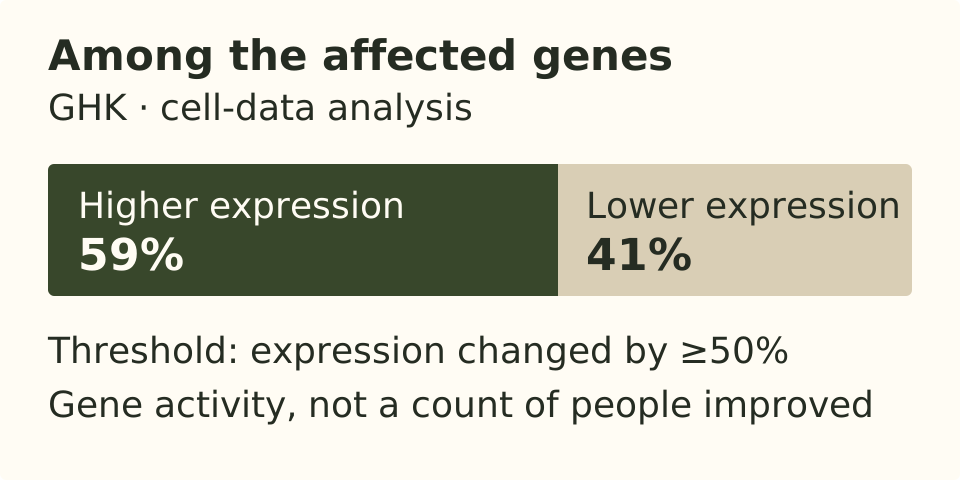
The number that drew me into GHK research was 31.2%. A review of gene-expression data reports changes affecting approximately that share of human genes, counting changes of 50% or greater. It sounds enormous. It also needs its second half: among the affected genes, expression increased for 59% and decreased for 41%.
Gene expression is the activity involved in using a gene's instructions; this analysis drew on experiments in human cells and a database of their responses. The peptide in that analysis was GHK. GHK-Cu is its copper-bound form, and the review brings several kinds of work together. Nobody in that gene analysis was being assessed for a younger face or a recovered tendon.
I expected GHK's numbers to tell a story about switching genes on. The downward changes complicate that story. Repair involves regulating activity, including turning some of it down. Counting the genes tells me how widely GHK may act. Whether any particular change helps a person remains a further question.
Human improvement
The address getpeptidetherapy.com contains an inviting verb. Getting something into a body, however, leaves the more interesting part of “therapy” unsettled: what gets better?
I prefer an improvement with an object. A wound gains skin coverage. A hair count rises. A movement test improves. Each is a result worth considering on its own terms. A long list of molecular changes can explain the interest in a peptide while leaving the practical outcome open.
That is why the small trial of a GHK-containing hair formulation deserves a different kind of attention from the gene count. It measured hair counts in men. It also tested a mixture, so the ingredients have to share the credit. The narrower result is more useful than a sweeping claim about renewal.
The peptide essays
GHK-Cu and skin begins with a copper-binding peptide, then moves between collagen measurements, a hair formulation and the difficulty of reaching living skin.
BPC-157 and blood vessels follows a particular growth signal through cells and animals. The vessel experiment is more specific than the broad reputation for healing.
TB-500 and measured healing separates the short fragment from full thymosin beta-4, then looks at wound coverage, heart function and movement after experimental stroke.
GLOW and combination claims asks how much an extra ingredient adds when the finished blend has no controlled trial. The proposed division of labour is attractive; the combined result is still missing.
The results comparison puts these different measurements beside one another without awarding a winner.
Safety evidence
More biological activity can raise questions about harm as well as benefit. A review of unapproved peptides in musculoskeletal research describes encouraging animal findings alongside scarce rigorous human safety data and the potential for serious harm.
I enjoy following GHK into these mechanisms. Human treatment evidence would be a bigger reason for enthusiasm. The safety discussion covers the brief human checks, the theoretical concerns about vessel growth and copper, and the risks that have barely been studied.